War Progression

War Progression #1–4

After finding a great photo of a soldier walking down a road, completely loaded with gear, my brain started developing a loose narrative for him and his experience during the war. When I say "my brain" I'm referring to my subconscious collating a lot of the research I'd been ingesting and presenting me with ideas I still don't have a complete understanding of.

Is this one soldier's progression during the war? Is it a physical or psychological progression? Both? Does it represent soldiers in a broader sense? Is it the progression of the war itself? All wars? Is it my own psychological progress while spending nine months on this WWI painting project? These paintings could represent all of those, and any "interpretations" I offer would only be retroactive; as much as I "planned" the compositions, colours, and techniques used in them, they weren't as consciously planned out, metaphorically or symbolically, as, say the three paintings of Toys or Hangin' on the Old barbed Wire (among a few others).

Initial drawings.

Photoshop tests.

The ideas my brain presented were these: #1 would be rather straight-forward; #2 would have a double image and a cut in the canvas which I stitch up with red thread; #3 would be utter chaos, stylistically; and #4 would be serene but moody with a stark white background. I tried these concepts in Photoshop to see if I liked any of those "directions" from my brain.

War Progression #1
20" x 16", oil on canvas, 2014

The straight-forward one; a brown background instead of green for better contrast. Ring on right hand unpainted, and a slash across his left leg, both showing the orange acrylic ground I use in almost all my oil paintings.

War Progression #2
work in progress

Like I said, giving my interpretations about what's going on in these paintings would be no more insightful than anyone else doing so. Guided by my subconscious, I can only guess at the double image symbolism here: is he literally beside himself, baffled by the horrors he's seen? Am I beside myself, afraid I'd be overwhelmed by the enormity of this project? (this mini series was done quite early on in the overall production (July-ish, I think)). Maybe both, maybe something else entirely.

War Progression #2
work in progress

Based on my brain's initial direction (and the initial Photoshop test) I thought this painting would end up mostly white, like he's in a snowstorm or is fading away from reality, but I still wanted to put in some details and sub-surface colours before the white-out occurred, with the thinking that this would give the final painting some depth and richness. Or not –it doesn't really matter if you can glean any of this in the final painting...at least I know it's there (and I have the photos to prove it!).

War Progression #2
work in progress

The cut. It had to be done. Most likely inspired by seeing a painting an artist (and former colleague) made where he slashed one of his paintings and then stitched it back together. There's certainly an injury/amputation/loss theme happening that my subconscious has a better understanding of than my awake-brain.

War Progression #2
work in progress

It had to be red thread and it had to be substantial. Krista suggested needlepoint thread which worked perfectly.

War Progression #2
20" x 16", oil on canvas, 2014

The final painting wasn't as white as I had imagined, but, as is, it's the way it has to be.

War Progression #3
20" x 16", oil on canvas, 2014

"Chaos" was the direction for this one. Absolute insanity. Even though it's very abstract and surreal, this could be in his head or a representation of external conditions. Whatever the hell the case is, I knew I had to look at some abstract art to get a sense of how I wanted this to end up.

I looked at a lot of different stuff, but my mind kept coming back to Jean-Michel Basquiat and his distinctive work. In the Photoshop test I ganged up a few of his paintings in various layers to get a feel for it and to see if it would work. Then I made up a composition in Basquiat's style but appropriate to my project. I was very satisfied with the result and this painting emboldened me to try other artists' styles (where appropriate) to diversify the story-telling in the overall project. It also helped me learn a lot about painting, trying to figure out how others did their work. Exciting!

War Progression #1 & #4
initial drawings (comparison)

I began the last painting with a very loose drawing of the soldier, thinking maybe the lines would be visible in the end, creating a kind of blurry effect, but then I kept adding things...

War Progression #4
work in progress

For richness and depth I used red and blue acrylic as the ground and, if I remember correctly, that's white gesso. I wasn't sure if the lines scratched into the gesso would be seen (even texturally), but they're there because they had to be. seriously: this mini series was like working on autopilot; if I believed in a muse I'd say I was guided by a muse. But it was my subconscious (through years of experience making paintings, and experiencing the world in its infinite variety) telling me to do things without explaining them. It's weird, but I'm satisfied with that understanding of it.

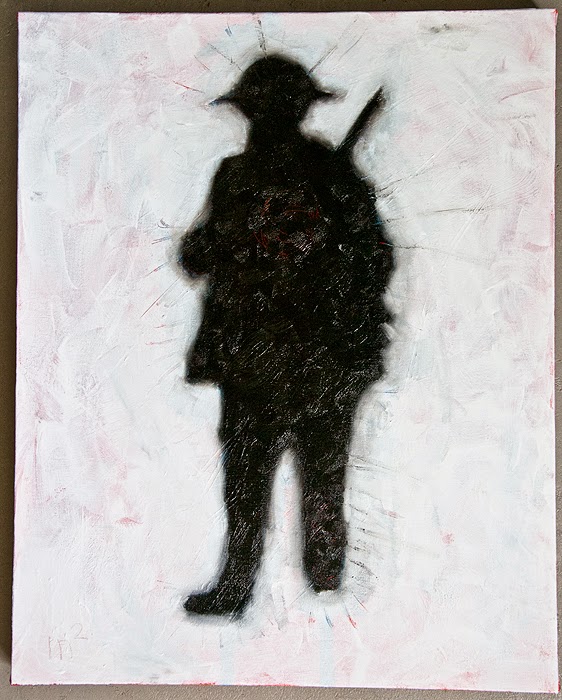
War Progression #4
work in progress

In comes the white oil paint after the blackness on the figure. I wanted something dark and textural, and for inspiration I was predominantly looking at the cover of Peter Gabriel's Passion album: 

"Study for Self Image II" by Julian Grater

I didn't mix as many media for my painting as Grater had for his (charcoal, bitumen, graphite, pastel, acrylic, beeswax, dry pigment, straw, and flower petals on paper), and mine's not quite as nuanced, but I knew it had to have a similar feel.

War Progression #4
20" x 16", oil on canvas, 2014

In the end I swirled the back end of my brush in the soldier's chest, revealing a tangle of red spirals, and scratched at the left leg, revealing red lines. Dripping water onto the leg made the paint run a bit, creating the trails.


Comments

Popular posts from this blog

Axel Foley's Chevy Nova (1/25 scale model)

Multiple tributes, here. I remember first seeing  Beverly Hills Cop  on video at my friend Chris K's house, 'cause his family had a VCR and we'd watch tons of movies (and record music videos) together. The summer of 1984 was a special time for us (having created a strong bond in school since Grade 6 a few years before), going on biking adventures around the 'burbs and into the city, etc., and home video played an important role from then until I moved to the opposite end of Scarborough just before we started high school. We liked the movie a lot, both of us fans of Eddie Murphy from his  Saturday Night Live  days. I don't think I'd seen the movie since then (it would have been 1985, probably summer, since the movie came out in late 1984) and I became curious to see if it still held up. It did. It does. I found Murphy as charming as ever and the comedy (and even the action) holds up very well and its very re-watchable and very entertaining.  Beverly Hi...

U.S.S. Enterprise, NCC-1701-D (1/1400 scale model)

Seven decades after Kirk. I'd been hooked on Star Trek since I was a wee lad in the 1970s, watching reruns of the original series from the '60s, and I enjoyed the movies that came out afterward. When a new series was announced to debut in 1987, I was excited and interested, even though I felt the subtitle "The Next Generation" was cheesy. Nearly 30 years later, I've definitely gotten used to it (but "TNG" is easier to say and type), but I still find it kinda bland. Anyway, the show had fresh new technology and a spanking new design for its main ship, the U.S.S. Enterprise , NCC-1701-D, now the flagship of the Federation. Andrew Probert 's design took some getting used to for me; it had the same basic elements of the original Enterprise  (saucer, neck, cylinder, and two cylindrical engines on pylons), but the shapes and volumes were distributed differently, weirdly. Everything looked squished and soft. The organic look of this new ship had me ...

U.S.S. Enterprise, Refit Restoration, Part 1

"All I ask is a tall ship And a star to steer her by" – John Masefield The original U.S.S. Enterprise , NCC-1701, designed by Matt Jeffries, first flew across TV screens in 1966 and was redesigned (chiefly by Jeffries, Mike Minor, and Andrew Probert) for Star Trek: The Motion Picture in 1979 (explained in the movie as having undergone a refit). I like the original design for its simplicity and elegance, but the refit really does it for me with its swept-back warp pylons and overall updated-yet-still-futuristic detailing. It's no wonder I picked this ship for my very first ever model. Check out this gorgeous scene of Scotty giving Admiral Kirk a tour 'round the outside of the Big E  in TMP (with beautiful music by Jerry Goldsmith). Which one did I build? The Star Trek V AMT/ERTL kit was issued in 1989, but I built it in the winter of 1991 (I remember there was snow on the ground in downtown Toronto, so it may have been early 1992, which means it ...